Leland Pavement Care works on driveways in Navassa, about ten minutes from Leland, and most calls start the same way. Navassa is a historic Gullah-Geechee community, and a lot of its driveways belong to homes that have been kept up by the same families for a long time. The drive has gone rough, and the owner assumes the only answer is to tear it out. Usually it is not. Done in the right order, driveway repair keeps an older drive in service and costs far less than starting over.
The work is a handful of plain jobs. The spots that have settled get asphalt patching: cut out, with the base under them rebuilt. The long working cracks that let rain into that base are closed by crack sealing, and crack filling takes care of the finer lines before they open up. A hole that has already broken through gets pothole repair, the same cut-and-rebuild as a patch.
When the damage is handled, the surface gets a finishing coat. Most owners think of driveway sealcoating first, but it only does its job on a sound drive, which is why it comes last. Laid over open cracks and soft spots, asphalt sealcoating just hides them for a season.
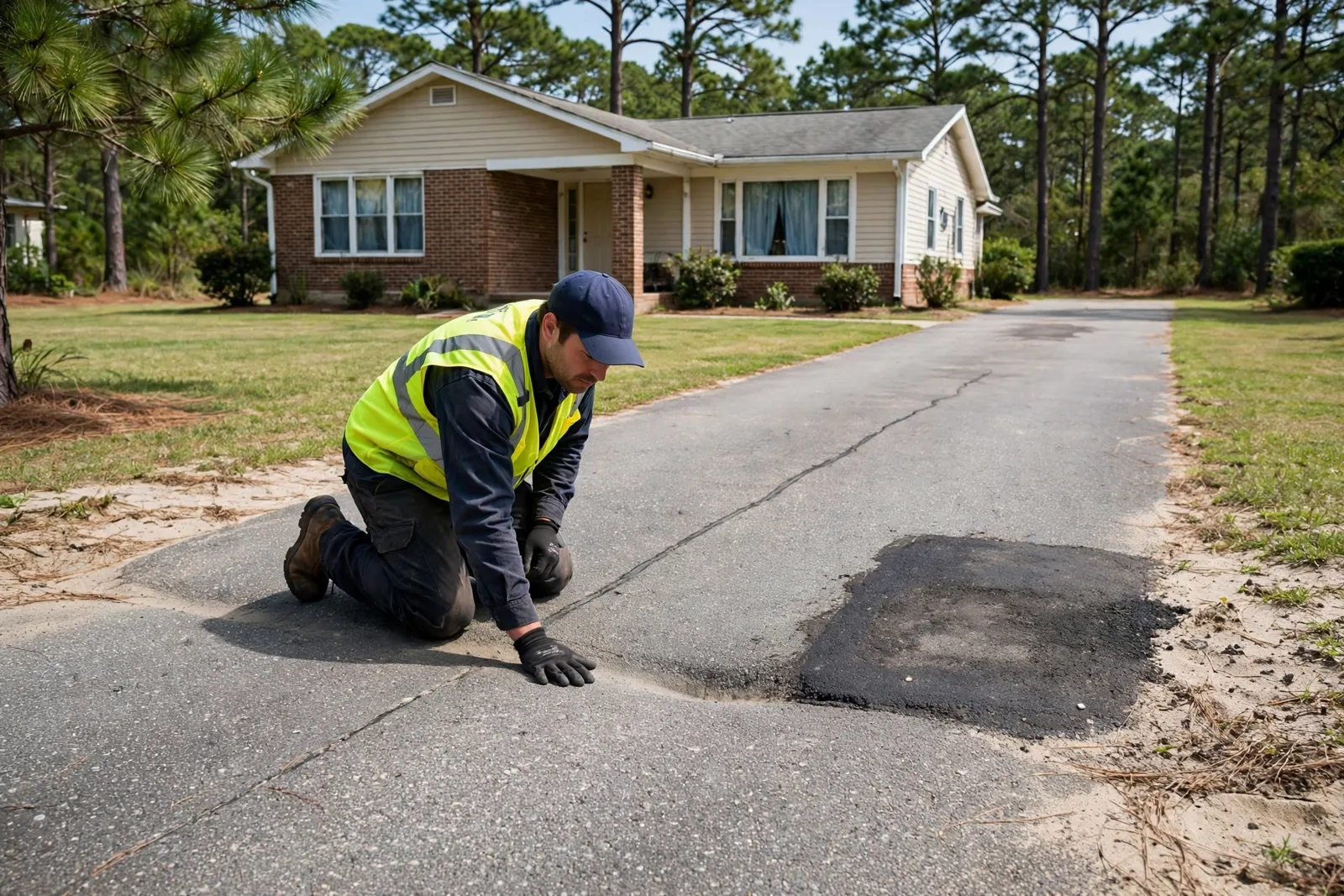
What a worn Navassa driveway looks like
Drives here are older and modest, and they have been kept, not replaced. That says something good about them. A drive that has stayed in use for a long stretch has usually held its base better than people give it credit for.
The ground is sand with a high water table, so the base under any drive in this part of Brunswick County depends on keeping water out of it. Summer thunderstorms and tropical systems drop inches of rain at once, and Hurricane Florence in 2018 showed how much water this county can take on. If rain finds an open crack, it runs down into the base and washes the sand out from under the asphalt. The surface follows it down, and a settled spot forms.
Four things wear asphalt on this coast. Sun and heat oxidize the surface until it turns gray and brittle. Water gets in through cracks. Oil and fuel drips soften the surface where cars park. And the base gives way under all of it. Those four map to the repair work: sealcoat handles the sun and the oil, crack sealing handles the water, and patching handles the base.
Here is what we look for when we walk a drive: - Spots that dip and hold a puddle after rain. - Cracks you can fit a pencil into, or ones with raised or broken edges. - Soft, dark patches under where a car usually sits. - Crumbling along the edges, where the base has lost its shoulder. - Old patches that have sunk or pulled loose.
Repair or replace: the honest answer in Navassa
Most worn driveways are repair candidates. That is the fair answer for older drives like these, where the base holds in most places and fails in a few.
The test is simple. If the asphalt is firm underfoot across most of the drive and the damage is in spots and lines, repair does the job. Cut out the weak places, rebuild them, seal the cracks, coat it. If the whole drive flexes and sinks when you walk it, the base has failed across the board and no patch will hold. In that case you need a full resurfacing or a new drive, and that is not work we do. We would rather tell you that on the walk than patch a drive that cannot be patched.
The money side points the same way. Repair is priced by the patch, by the foot of crack, and by the coat. Resurfacing is priced across every square foot of the drive at $4 to $8 per square foot. On an older drive with two bad spots and some cracking, you would be paying for the whole surface to fix a small part of it.
The Broadway Street driveway
A family had kept their driveway off Broadway Street for a long time. It had two spots that had sunk, several cracks that opened wider every summer, and a surface gone gray. The owner called assuming it needed replacing. The walk said otherwise.
The walk. The crew walked the whole drive from the road to the house before anyone talked price. They pressed along the edges, looked at where water stood after the last rain, and followed each crack to see whether it ran in a line or branched out. Two areas had settled. The cracks were working but not broken apart. The rest of the drive was firm. That made it a repair job.
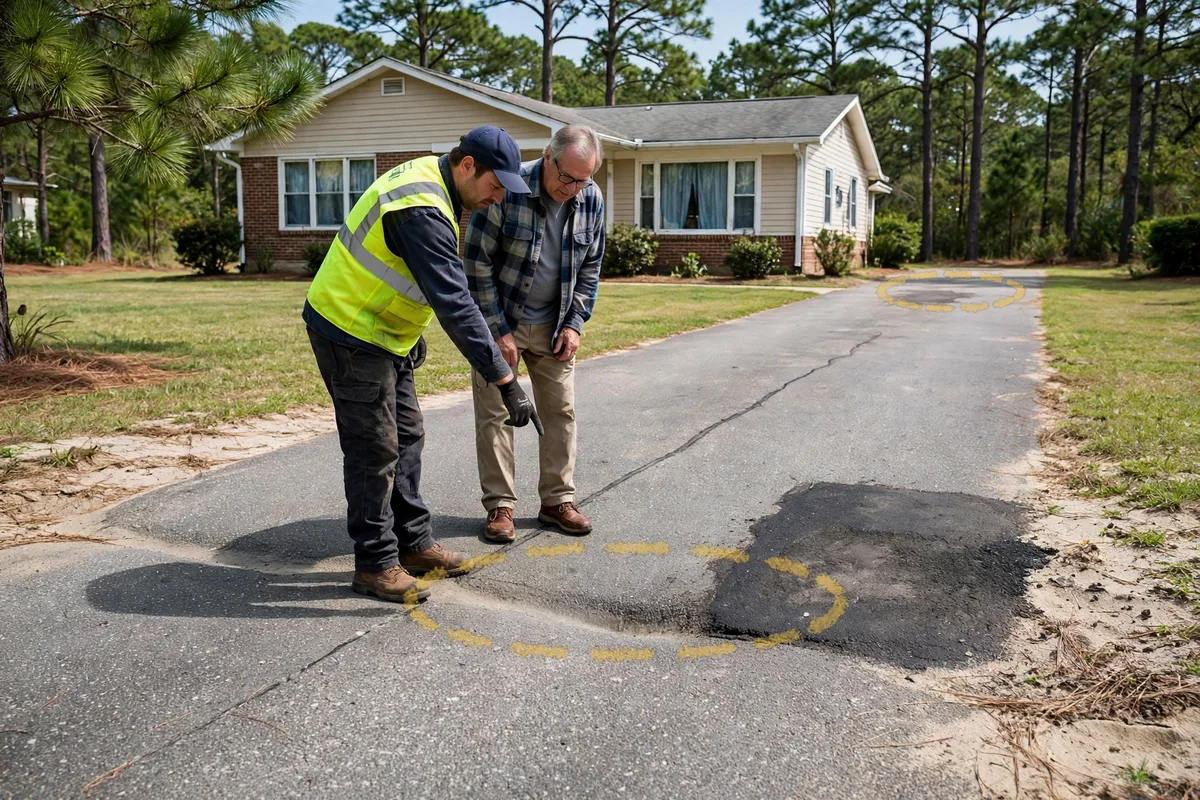
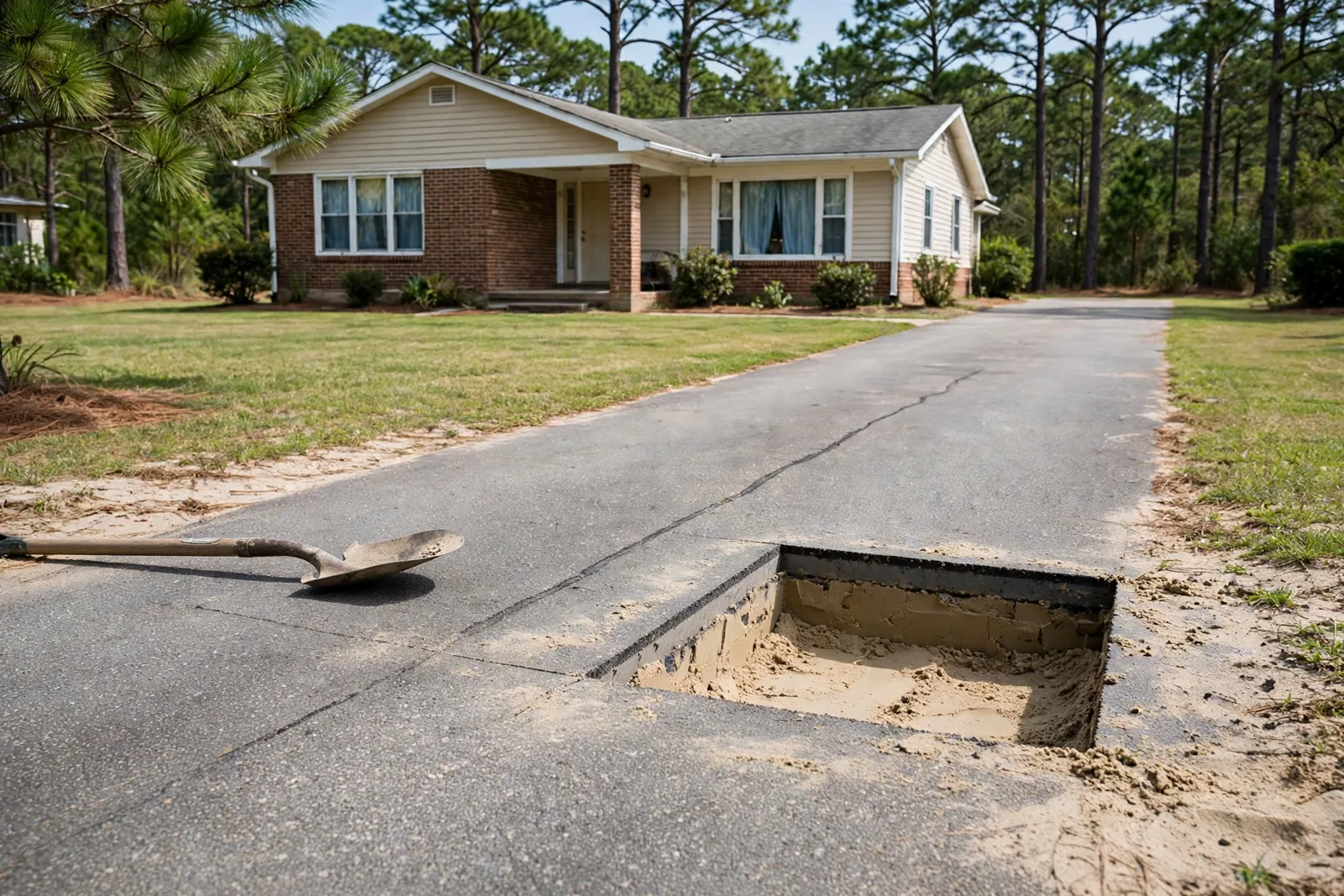
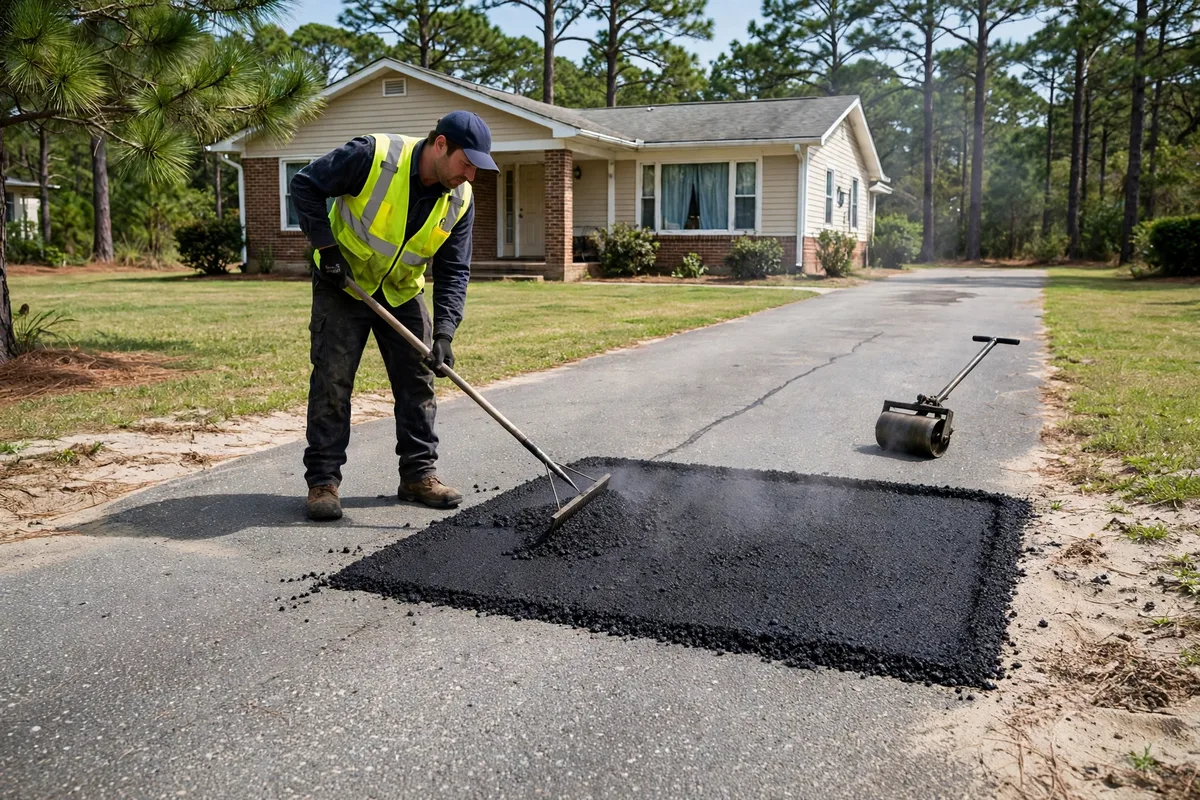
The two patches. The crew saw-cut each settled area to square edges, then removed the asphalt inside the cut. Under the first one, the base was wet and loose, sand that had been moving for years. They dug it out, brought in new base, compacted it in layers, and filled the cut with hot-mix asphalt, rolled tight and flush with the old surface. The second was done the same way. Cutting square and rebuilding the base is what separates a patch that lasts from a skin patch that sinks again.
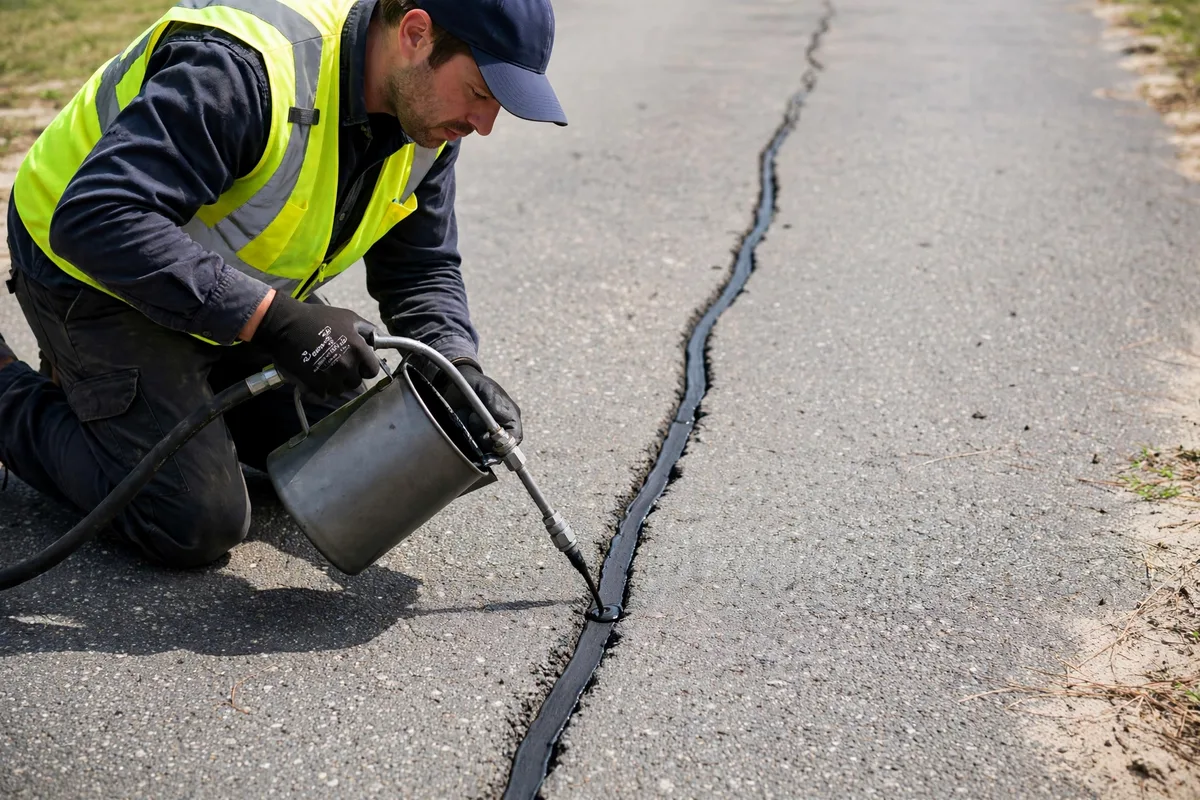
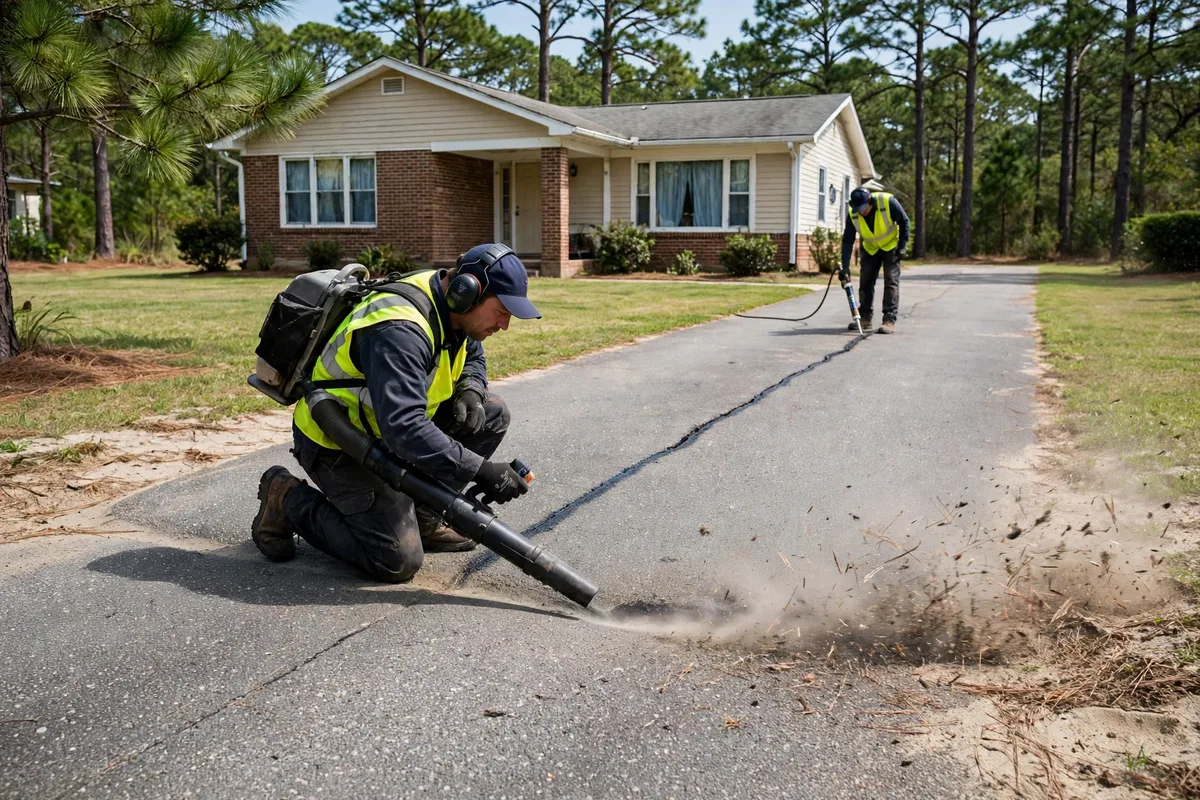
The cracks. The working cracks were cleaned out with a blower and brush, then filled with hot-pour rubberized sealant, which stays flexible as the pavement moves with heat and cold. Cold-pour and store-bought filler are the short-lived contrast. They tend to pull out of the crack in a season or two.
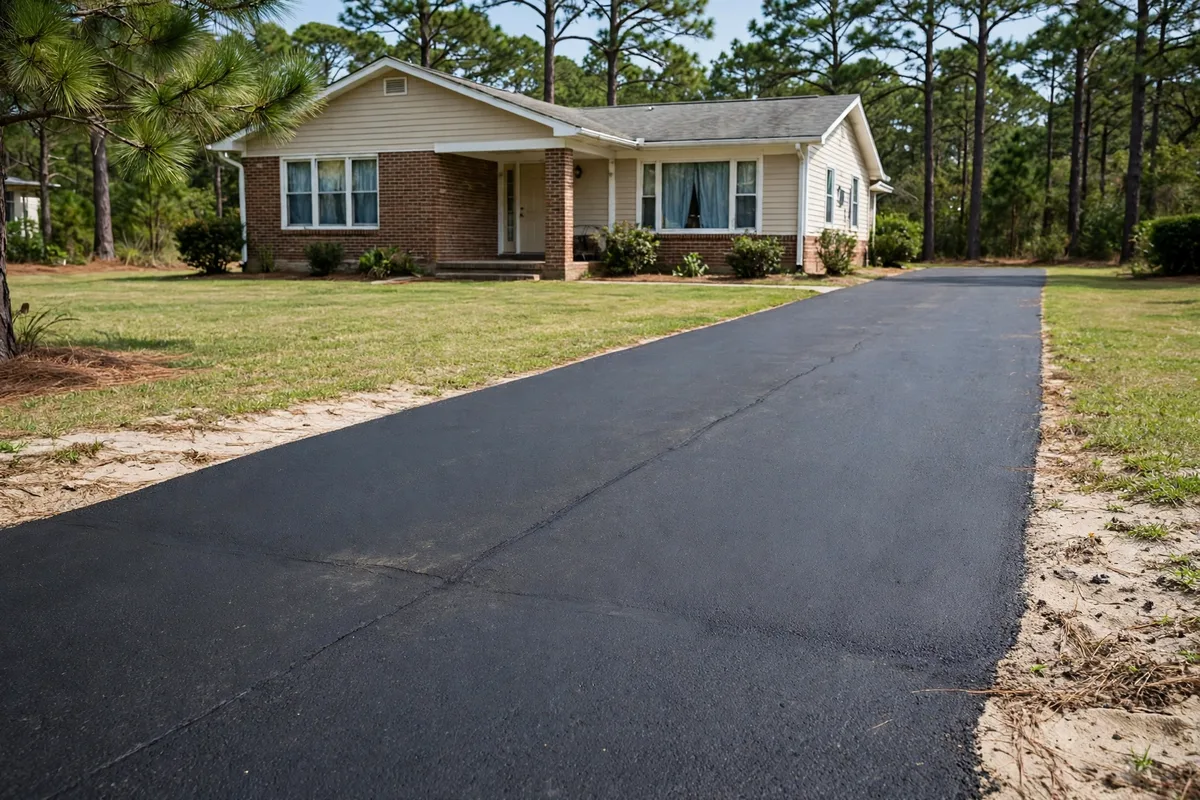
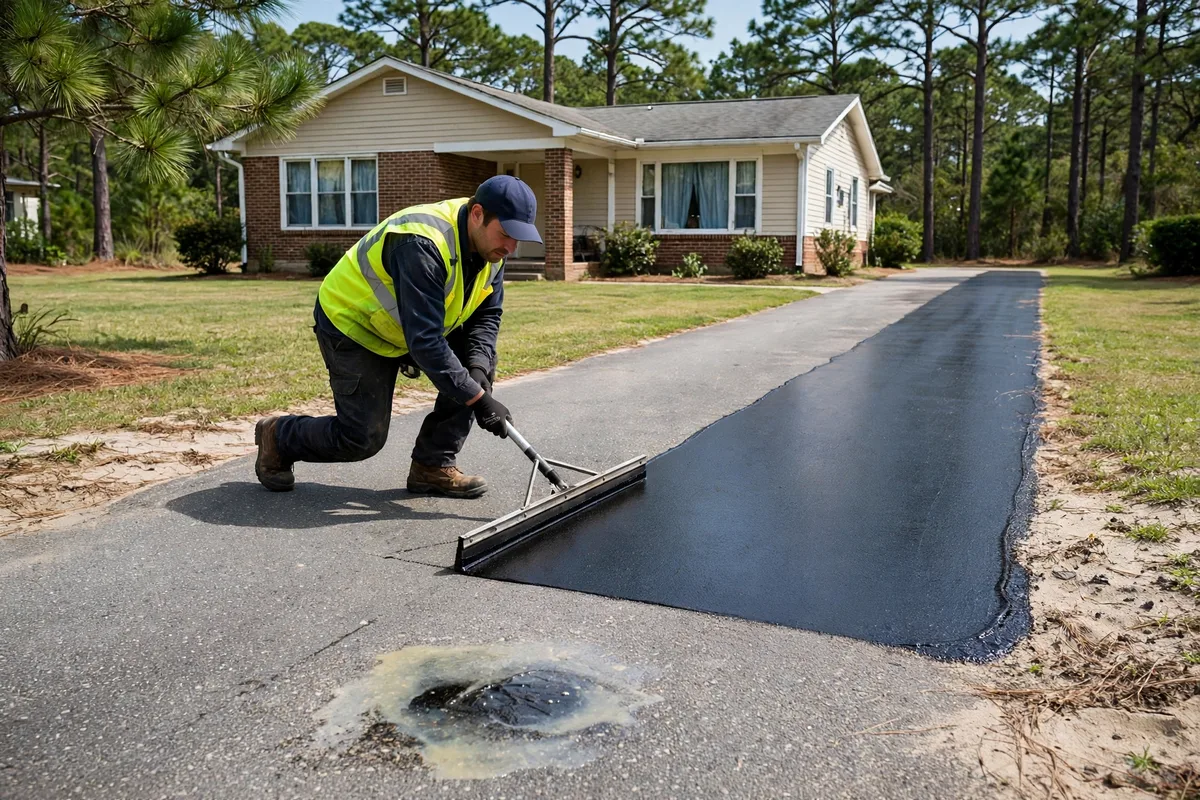
The finishing coat. Oil spots under where the cars park were primed first so the sealer would stick. Then the whole drive got a coat of asphalt-emulsion sealer, worked in by squeegee along the edges and patches. The new patches and the old surface came out one even color.
Work the Broadway Street decision yourself
Repair or replace
Count the spots on your drive that dip, hold water, or have sunk. Each one is cut out, re-based and patched with hot-mix. Patching runs $150 to $400 per pothole class repair, and larger settled areas are priced by the square foot on area. Size, depth and base condition drive the price.
Measure the cracks in linear feet by walking each one. Crack sealing runs $0.50 to $3.00 per linear foot. Hot-pour rubberized sealant is the professional method, and it goes into clean cracks.
Sealcoat goes on last, once the spots and cracks are done. Driveway sealcoat typically runs $600 to $2,000. Size, condition, crack filling and oil-spot priming set where a drive falls in that range. Minimum fees apply on small drives.
Walk the drive. If the asphalt is firm underfoot across most of it, the damage is in spots and lines, and repair is the answer. If the whole drive flexes and sinks, the base has failed throughout and repair will not hold. The overlay comparison is $4 to $8 per square foot across the whole drive: multiply your drive's square feet by $4 and by $8 to see the range, then set it beside your patch, crack and coat tally.
Mostly spots and lines, firm everywhere else: this is a repair job. or "Soft and moving across the whole drive: repair will not solve it, and we will tell you so on the walk."

The numbers. The two patches fell in the pothole-class band of $150 to $400 each. The cracks were priced by the linear foot within $0.50 to $3.00. The finishing coat sat inside the $600 to $2,000 range for a driveway sealcoat. Measured against resurfacing every square foot at $4 to $8, the owner paid for three targeted repairs and a coat instead of covering the whole surface.
What to watch for. Check the patch edges after the first heavy rain. If water stands on a patch or a hairline opens along its border, call, because that is the first sign of a problem. Keep new oil drips off the coat. And when the surface starts to gray again, a fresh coat is the next step, not a rebuild.
How the repair goes
Each step happens in this order, and the order is the point. Skipping ahead is how repairs fail.
1. Walk and sound the drive. The crew walks the whole surface, presses the edges, and notes where water stands. This decides repair or replace before anything is priced.
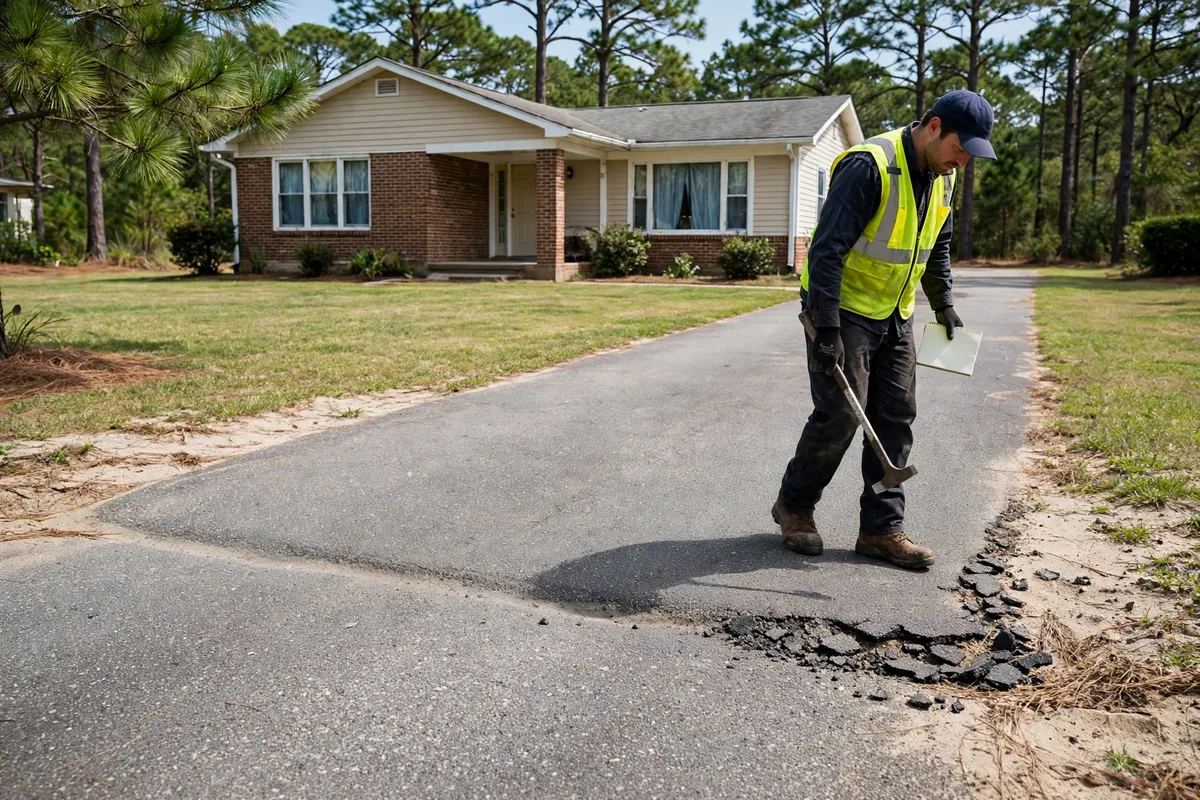
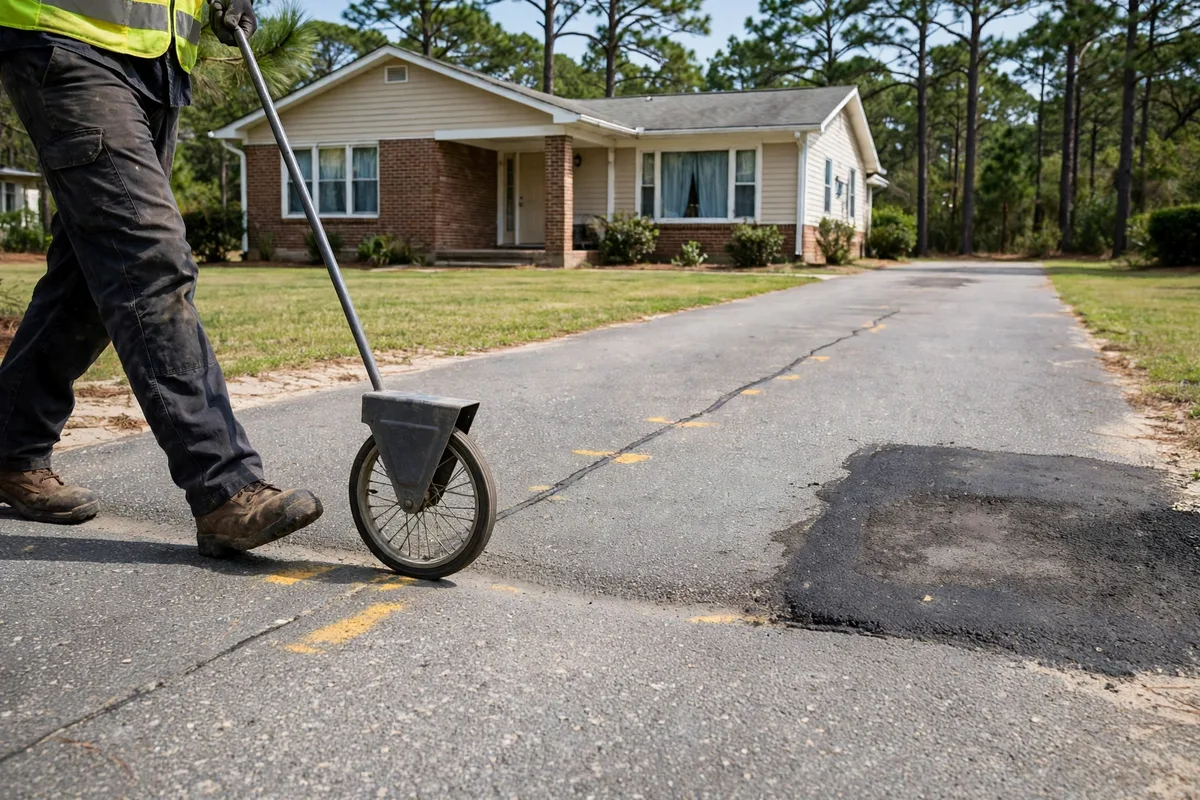
2. Mark and measure. Settled areas are outlined with paint, and cracks are measured in linear feet. The marks become the scope you see priced.
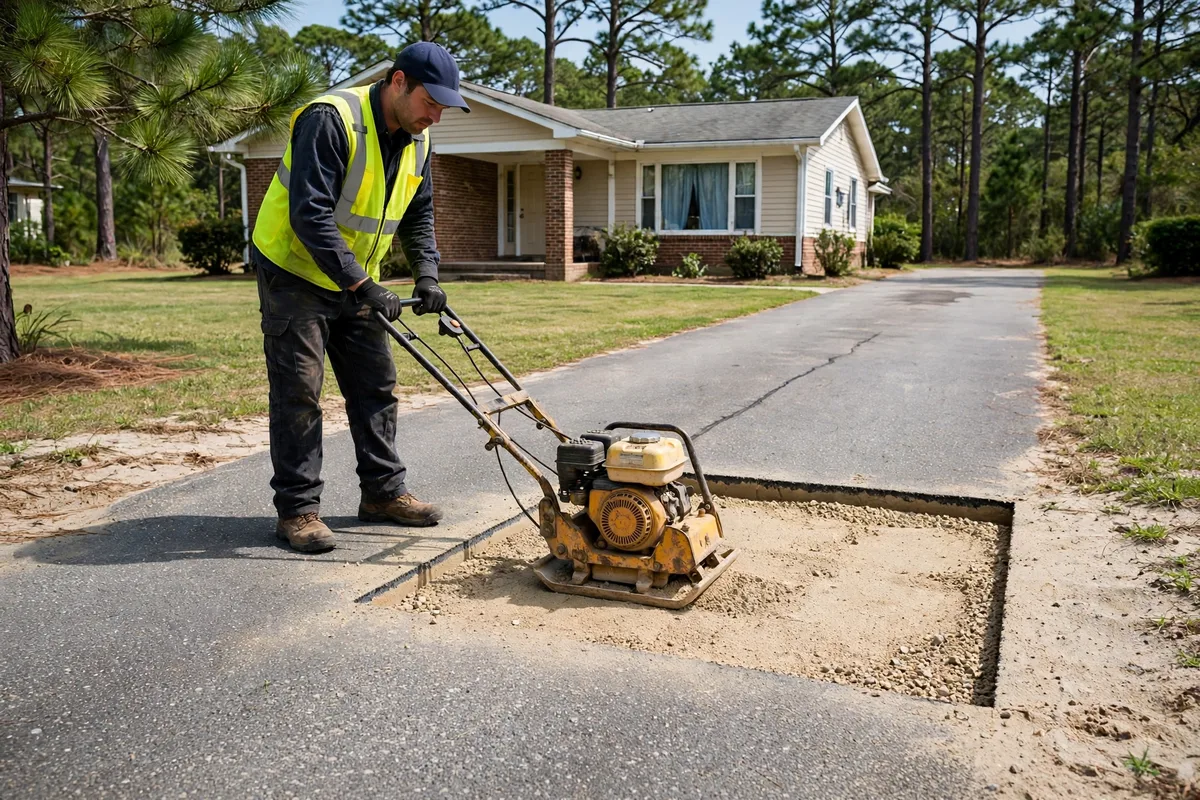
3. Cut out and re-base. Failed areas are saw-cut square, the old asphalt and loose sand are removed, and fresh base is compacted in layers.
4. Hot-mix patch. Hot-mix asphalt goes into the cut, is raked level and rolled tight and flush with the surrounding drive.
5. Clean and seal the cracks. Cracks are blown and brushed clean, then filled with hot-pour rubberized sealant.
6. Prime oil spots and apply the finishing coat. Oil stains get a primer so the sealer bonds, then the sealcoat goes on over the whole drive.
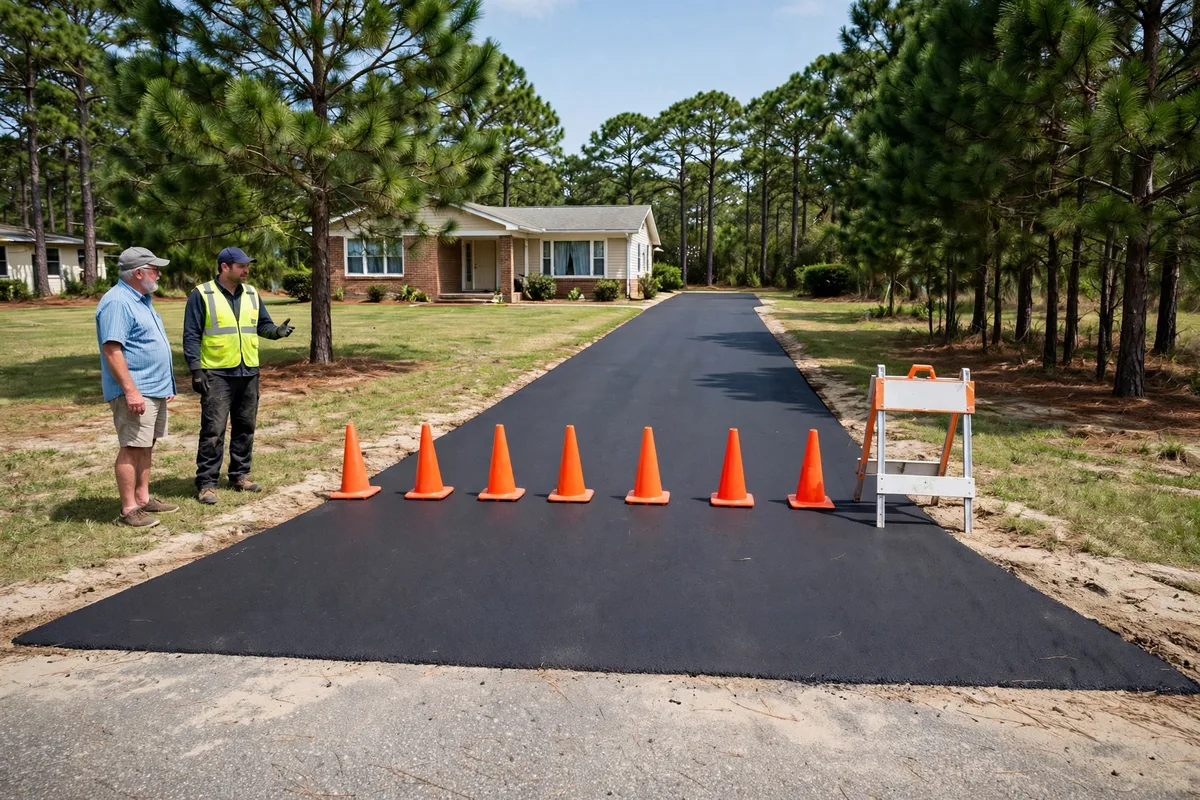
7. Barricade and walk it with you. The drive is coned off, and we go over the repairs with you before leaving and tell you when it is safe to drive on.
What it costs
These are our prices for driveway work, and what moves them is size, depth, base condition and prep.
- Patching: $150 to $400 per pothole class repair. Larger settled areas are priced by the square foot on area. Size, depth and the condition of the base underneath decide where a patch lands.
- Crack sealing: $0.50 to $3.00 per linear foot, by the foot of crack we seal.
- Driveway sealcoat: $600 to $2,000 typical. Size, condition, crack filling and oil-spot priming set the number. Minimum fees apply on small drives.
- For comparison, resurfacing the whole drive: $4 to $8 per square foot.
A drive with two bad spots and several cracks adds up as patches, plus feet of crack, plus a coat. You can run the numbers yourself with the walk above, and the crew confirms them on site.
Keeping a repaired drive in shape
Once the base is sound and the cracks are sealed, the drive needs care, not a rebuild. Most owners reseal every two to three years, which is typical practice, not a promise about any coating. Fill new cracks when they show up, because water is what starts the next settled spot. Wipe up oil drips, and keep gutters and downspouts pointed away from the edge of the drive.
Questions
Is my old Navassa driveway worth fixing?
Most of the time, yes. If the asphalt is firm across most of the drive and the damage is in spots and cracks, repair is the right call. We walk the drive first and tell you straight if it is past repair.
Do you work in Navassa?
Yes. Navassa is about ten minutes from Leland, and we work driveways there regularly.
How much does it cost to fix a sunken spot?
Patching runs $150 to $400 per pothole class repair. Larger settled areas are priced by the square foot on area, and the size, depth and base condition set the figure.
How much does crack sealing cost?
Crack sealing is $0.50 to $3.00 per linear foot. We measure the cracks on your drive and price by the foot.
How much is a sealcoat on a driveway?
Driveway sealcoating typically runs $600 to $2,000. Size, condition, crack filling and oil-spot priming set the price, and minimum fees apply on small drives.
What would replacing it cost compared to repairing it?
Resurfacing the whole drive is $4 to $8 per square foot. Repair is priced by the patch, the foot of crack and the coat, so on a drive with a few bad spots it comes in well under covering the whole surface.
Do you pave new driveways or do overlays?
No. We repair and maintain asphalt. If your base has failed across the whole drive, we will tell you that repair will not hold and that you need a different kind of contractor.
Why does my driveway keep sinking in the same place?
The base under it has moved, usually from water. Sandy soil and heavy rain wash the sand out from under cracked asphalt. A surface patch will sink again, so we cut the spot out, rebuild the base and patch with hot-mix.
Can I just seal over the cracks?
Not on cracks that are open or moving. Sealcoat over open cracks hides them for a season while water keeps getting in. We seal the cracks first, with hot-pour rubberized sealant, then coat the drive.
Is hot-mix really better than cold patch?
For a lasting repair, yes. Cold patch and skin patches are temporary fixes. A saw-cut, re-based hot-mix patch is the durable repair.
How often should a repaired driveway be sealed?
Most owners reseal every two to three years. That is typical practice, not a guarantee for any coating or pavement.
Do I have to do the patches, cracks and coat all together?
No. You can have patching or crack sealing done on its own. We usually recommend the coat last, though, because it works best on a drive with sound spots and sealed cracks.
How soon can I drive on it?
The crew tells you on the day when it is safe, and the drive is barricaded until then. Wait for that word before pulling in.
Tell us about your driveway
If your drive in Navassa has dips, open cracks or a surface gone gray, give us a call at (910) 370-1121 or send the form. We will walk it, tell you whether it is a repair, and give you the figures. The decision to repair or replace is easier to make once someone has stood on the drive.
The more details you give, the better we are able to help you.